FNQ – Far North Queensland birding

IMG_0466

Southern Cassowary – finally puts in an appearance at the Jindalbah car park

After the successful Port Stephens pelagic – which enabled me to reach 300 birds in the Hunter, we flew north to Cairns to meet up with my brother Rob and wife Gi for a birding trip of far North Queensland. Unfortunately, the hoped for prize of the first day and a half – Southern Cassowary, failed to materialise. Despite being at Mission Beach – the epicentre for recent Cassowary ‘hunting’, it rained continuously and we failed in our mission (pun intended) miserably. We then headed north, via Port Douglas, to the Daintree River, where we did manage to connect with some of the region’s specialities – finally tracking down Southern Cassowary at Jindalbah, but not before a three hour wait in the car park and a narrow miss of a Noisy Pitta! A couple of hours flying time further north is the small, by Aussie standards, national park of Iron Range – a fragment of tropical low-land rainforest, with a dozen or so endemic specialities. Here we stayed at the lovely bed & breakfast at Portland Roads and ate in the adjacent cafe – tremendous food at literally the end of the road! An over-night stay in Cairns, before returning south, allowed for a couple of visits to the world renowned wader hot-spot of The Esplanade and an early morning bird of the Botanical Gardens.

Common in north Queensland, Bush Stone-curlew – this one was seen in Cairns Botanical Gardens

IMG_1579

Comb-crested Jacana – present on most suitable inland waters in North Queensland

IMG_9861

Also present, Salt-water Crocodile – this one was seen on the Daintree River cruise

IMG_0202

Also seen along the Daintree River, one of a number of Kingfisher species – this one is Azure 

IMG_0198

Restricted to the rainforests of northern Queensland is Macleay’s Honeyeater

IMG_0148

Similar to the above species is Tawny-breasted – one of three Honeyeaters ‘endemic’ to Iron Range  

IMG_1198

Cape York endemic Monarchs include this little cutie – Frill-necked 

IMG_1446

Much more common but equally as appealing – Olive-backed Sunbird, the only representative of this diverse group in Australia

IMG_0234

We did eventually catch up with Noisy Pitta but were too early for it’s rarer cousin Red-bellied, which is only a wet-season visitor to Cape York

IMG_1389

Water birds were few and far between, but these Pied Heron at Lockhart River ‘poo ponds’ were a welcome exception

IMG_1241

Evening entertainment was provided by this murmuration of Metallic Starlings off Restoration Island

IMG_1108

Reasonably common in Iron Range is Magnificent Riflebird – not quite so easy to see though!

IMG_1119

A top prize in Iron Range is the restricted and endangered Fawn-breasted Bowerbird

IMG_1547

Equally prized, in their only Australian foot-hold of Iron Range, is Eclectus Parrot – we found this male (green) and four females (red) at their nest-hole. Seeing this beautiful bird has been a birding ambition of mine for many years – I even named my Management Consultancy after it!

Untitled

More common, but still difficult to see, are these Double-eyed Fig-Parrot – Australia’s smallest parrot species

IMG_1410

The last species added to the list in North Queensland was this fabulous roosting Rufous Owl – located by a kindly birder I met in the Botanic Gardens who gave me a lift back to the hotel. We managed to photograph it in the final minutes before the taxi took us to the airport! Here, in typical pose, with prey in his talons 

IMG_1649

Magic Pelagic brings up my 300th

Campbell Albatross, my 300th for the Hunter – note the amber eye a key id feature from Black-browed. Also an Australia Tick

Yesterday it was up early to get the pelagic out of Port Stephen’s. Only a couple of days earlier the forecast was such that it would have been cancelled but fortunately conditions improved to permit a sailing. It takes three and a half hours to get to the shelf, allowing three full hours prime oceanic birding. We’d already seen Brown Skua (297) on the way out. Once we got to the shelf we saw our only Indian Yellow-nosed Albatross (298) quickly followed by Providence Petrel (299), leaving just one more species to reach the magic 300! As predicted, it came in the shape of a Campell Albatross – a fairly recent split from Black-browed and, as a bonus, an addition to my all-time Australia List. In addition to the new Hunter species, we had Wedge-tailed, Hutton’s, Fluttering and Short-tailed Shearwater, White-faced Storm Petrel, Australasian Gannet, Wandering (Antipodian) and Shy Albatross (probably White-capped), Bar-tailed Godwit. Not a bad trip!

Brown Skua – the first of the mornings new species

Providence Petrel (Solander’s) – photo courtesy of Dan Williams

Indian Yellow-nosed Albatross – one of five species of Albatross seen

A Trip to the Baths

White-fronted Tern, amongst Crested Tern – Newcastle baths

Today, it was an early morning trip to the baths – Newcastle’s outdoor swimming pool, to search through the roosting Crested Tern flock in the hope of finding White-fronted Tern, another winter visitor to the NSW coast, and a Hunter tick. It didn’t take Dan long to locate the only two birds present amongst their bigger cousins. I also located a Crested Tern with double metal leg rings – partially readable.

On the way back home we called in at Bunnings DIY store to add another Hunter tick – Mallard. Whilst the male looks reasonably pure and apparently sufficiently ‘tickable’, the female has more than a gene or two of Black Duck in her I’d say.

296, with hopefully one or two more additions on tomorrow’s planned pelagic, out of Port Stephens.

Hunting down those Hunter ticks

A lone Double-banded Plover,  found along a stretch of the 40k Worimi Conservation Land (Stockton Beach). First Hunter tick of 2017 

We’re over in Australia at the moment, visiting our son and his family, holidaying with my brother and hunting down those Hunter ticks! This must be our fifth trip to Newcastle since Dan, Morgan and the kids have lived here and, in addition to boosting my all-time Australia list – which now stands at over 500, I’ve been slowly amassing my Hunter Bird Observers Club list, in the hope that I might meet their ‘entry level’ Bronze standard of 300 species. At the end of our last visit I was frustrating close, on 291.

Grey Plover – another ‘Hunter tick’

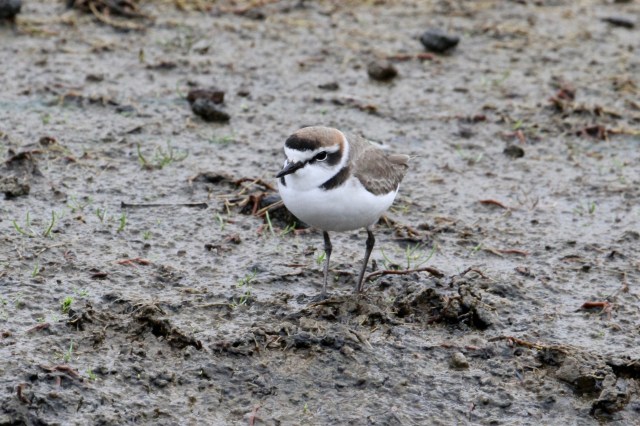
We arrived here from Sydney airport yesterday mid-morning and, with barely a half-hour turn-around, we were back out the door, bound for Worimi Conservation Land (Stockton Sands), in pursuit of our first Hunter tick of the trip. A small group of Double-banded Plover winter along this 40k stretch of beach – said to be part of the largest dune system in the southern hemisphere. Most of these birds have now left the Hunter, bound for New Zealand where they breed, but my brother did photograph one about ten days ago, when he and Gi were visiting. We’d driven more than half the length of the beach before we finally came across a lone individual – phew! Waders were few and far between, but we did see Red-capped Plover, Pacific Golden Plover, Grey Plover (another Hunter tick) Curlew Sandpiper, Pied Oystercatcher, Great Knot and Sanderling. On our way home we stopped-off to collect Freckled Duck – usually a difficult species to track-down anywhere in NSW, as my third addition for the trip. 294 – we’re on target to reach the magic 300 before we leave (fingers crossed!).

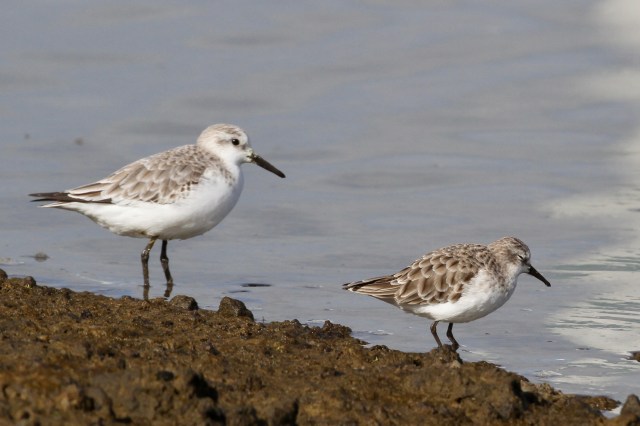
Other wader interest coming in the shape of Great Knot and Sanderling

and Gull-billed Tern


Evros Delta to Thessaloniki

The ever-present White Stork, here along the shores of Lake Koronia

Our final day in Northern Greece was spent in a long, leisurely transit from our base in the Evros Delta to the airport at Thessaloniki, via the Nestos river delta and Lake Volvi. We saw plenty of good birds, including several high mountain species at the now derelict ski-centre on Mount Paggeo – N.B. the track from there to the radio mast is now only navigable on foot.

Distant views of Mount Paggeo 

Mount Paggeo – the only place we saw Ortolan Bunting, but they were here in good numbers

Distant views of an elusive male Rock Thrush

Horned Lark, seen just below the radio mast on Mount Paggeo. Considered to be breeding, so we kept our distance

Tawny Pipit – a surprise species to find high up in the mountains

A last look back to Lake Volvi before heading for the airport and home..

We were very impressed with our first trip to Northern Greece. Thanks again to Steve and Hilary for their gentle encouragement to visit. The birding was excellent, the scenery superb and the people friendly and helpful.

To view our annotated checklist, of all 165 species seen during our week-long holiday, follow this link.
Long-billed Dowitcher – 350th for Norfolk!

Distant grab-shot of Long-billed Dowitcher, Cley NWT

This morning’s Long-billed Dowitcher at Cley NWT, was my 350th bird for Norfolk. Not a big score I know, compared with the serious County listers, but as a relative new-comer to this part of the world I’m pretty pleased! The bird, well-found by Jake Gearty and Co, played cat and mouse with the 50 or so birders stationed along East Bank, as it moved between the tussocky grass of The Serpentine and Arnold’s Marsh.

and again, with wings out-stretched


Rodopi Mountains to the Evros Delta – part 2

Spur-winged Plover, breed in small numbers on the Evros Delta and along the coast – stunning birds!

From Lake Kerkini we headed east, first to the excellent Kyveli Hotel at Kariofito, in the Rodopi Mountains, and then, via Porto Lagos, on to the Evros Delta, close to the Turkish border. In the mountains we explored the road which heads north from the hotel to the Forest Village (for details see Steve Mills’ book p110), now largely derelict. There was excellent birding along this road including Rock & Cirl Bunting, Eastern Orphean Warbler and five species of woodpecker, including Black – just south of the Forest Village. The following day we visited the various lagoons and salt-works in the Porto Lagos area, seeing a few late waders, flamingo, terns and gulls, before finally arriving at the Hotel Isidora, practically opposite the Evros Delta Visitors Centre. We had a day and a half to explore the delta, which is divided into two sections West and East – for which a permit is required, in advance.  We quickly discovered that the delta is vast and slow to circum-navigate but packed full of interesting wildlife – in addition to the many and varied birds, we had good views of Golden Jackal and Wild Cat. We also managed to squeeze in an early morning visit to the Dadia forest, taking the mountain road to the Kapsalo transmitter mast view-point. Here, we eventually caught up with both Black & Egyptian Vulture and Blue Rock Thrush.

Cirl Bunting were relatively common in the Rodopi Mountains – here an adult feeds a youngster

Rock Bunting were, however,  much less common – seen between Kariofito and the Forest Village

On the lagoons around Porto Lagos, Flamingo with a group of Greenshank and several Slender-billed Gull

Whilst birdwatchers are free to visit the western Evros Delta, you do need a permit, arranged in advance, to visit the eastern delta, close to the Turkish Border 

On the Evros Delta there were still a few migrant waders, including Wood Sandpiper

Distant Marsh Sandpiper – part of a group of 20 – 25 with just a few of the flock of 350+ Ruddy Shelduck, in the background

These distant Collared Pratincole were a delight to watch, hawking for insects over the flooded rice fields

Surprisingly, we only saw a couple of Purple Heron

Along the many tracks which bisect the Evros Delta, several Greater Short-toed Lark

and Calandra Lark

To our delight, on our first evening in the delta, this juvenile Great Spotted Cuckoo

One species we did see in reasonable numbers, both here and back at Kerkini, was Turtle Dove. Weird how the pattering on the coverts make the bird look out of focus!

Distant views of one of two Black Vulture seen at Kapsalo

On our last day in Northern Greece we had a long drive back from the Evros Delta to Thessaloniki – but we still managed to fit in some birding on route.. see my next blog for details!

Greek dragons

Male Black-tailed Skimmer

Whilst editing the next batch of bird photos, from our recent trip to Northern Greece, I thought I’d feature a few of the dragonflies we saw. I’m reasonably confident about the identification but, as a relative beginner to this interesting taxa, I’m always happy to receive comments and corrections. Not surprisingly I failed to photograph a goods number we saw but of those I did, I added at least seven to my slowly growing list of European ‘drags’.

Female Black-tailed Skimmer

White-tailed Skimmer

Scarlet Darter or Broad Scarlet

Green-eyed or Norfolk Hawker

Southern Skimmer

Keeled Skimmer

Blue Chaser

Banded Demoiselle

Beautiful Demoiselle, festiva

Bladetail

Yellow-winged Darter

River Clubtail

and final, though not strictly a dragonfly, Antlion

Next blog will be the birds of the Rodopi Mountains and Evros delta…

Greek Lakes to the Evros Delta, wildlife highlights – Part 1

We knew, when we were planning this trip, that we would be too late for Spring migrants, so our expectations for a week’s wildlife watching in early June were suitably modest. In the event Northern Greece turned out to be an excellent choice – during the week we racked up 166 bird species, plenty of butterflies & dragonflies, flowers, snakes, mammals and more.

We flew with Ryanair from Stansted to Thessaloniki and did a circular tour of the north east, from Lake Kerkini to the Evros Delta – using Steve Mills’ guide, Birdwatching in Northern Greece, as our bible. We booked all accommodation on-line or through email and were able to pay at most places with a card – there was reasonable access to ATM’s in the bigger towns. Hire car was booked through Ryanair with Hertz, who are in the terminal, with just a short bus-ride to the vehicle pick-up point. Petrol is an equivalent price to the UK but, due to the ailing Greek economy, there are fewer cars on the roads than you might expect, making driving in the countryside a pleasure (watch out for the pot-holes though!). People were very friendly, helpful and had enough English for us to get by. This is definitely a location to be recommend and we’re looking forward to a return visit soon.

Our tour started at Kerkini, a huge man-made lake, created in the ’30’s by the damming of the Strimonas river, covering up to 72 km sq. The thing you notice immediately about the surrounding area is the relatively low-intensity agriculture, with lots of uncultivated areas, rough grazing and overgrown hedgerows. As a consequence, lots of wildflowers, insects and birds – four species of shrike breed in the area, with Bee-eaters everywhere and Roller all feasting on the abundant prey.

Red-backed Shrike are common, with fewer Lesser Grey, and Woodchat – Masked also present

There were Bee-eaters everywhere!

Roller are well distributed, helped by the provision of nest-boxes, particularly around the Evros Delta, made possible by BirdWING (birdwatching in Northern Greece) – the conservation charity, set up by Steve and Hilary Mills

The lake is an internationally important wintering location for wildfowl of every variety but is critical important in respect of globally threatened Lesser White-fronted Geese.

It’s also the breeding location for pelican – with both White and the globally threatened Dalmatian, present in good numbers

Heron and Egret species can be found in abundance around the lake, along with both storks and Glossy Ibis

Lake Kerkini is an important breeding location for Pygmy Cormorant

I’ve never seen so many Great Crested Grebe – there were hundreds of breeding pairs

In the surrounding hills and mountains, which form the border with Bulgaria, there were plenty of raptors including a flock of 20-25 migrating Red-footed Falcon, several Eleanora’s Falcon, and a Golden Eagle.

Eleanora’s Falcon

In the next part, the birds of the Evros Delta and the Rodopi Mountains..


Coming soon – highlights of our wildlife week in Northern Greece

Squacco Heron – one of fifty or more seen along the north east shore of Lake Kerkini, Northern Greece

We’ve been meaning to visit Northern Greece ever since we came across Steve & Hilary on the Lake Kerkini and Birdwing stall at the Rutland Water Birdfair, a few years ago. They, along with Nikolaos, who runs an excellent hotel for birders close to the eastern shore of the lake, do a fabulous job of promoting bird conservation in this beautiful but threatened corner of Greece. Armed with a copy of Steve’s site guide, Birdwatching in Northern Greece, we, accompanied by our youngest son Jake – a passionate birder himself, recently enjoyed a weeks birding and general wildlife watching holiday exploring the numerous sites between Lake Kerkini and the Evros Delta. A full annotated check-list and selected photos will appear on this blog in the very near future.