Norfolk’s Awesome Autumn

It’s been an exceptional week for autumn migrants, along the north Norfolk coast. Starting last Sunday with the Isabelline Shrike at Beeston, the birding action has been pretty continuous since then. We’ve had our long-time birding buddies Bob & Sue staying with us for the past few days and have spent most of our time on the coastal strip between Sheringham and Wells, searching out some of the rarities. It’s not been a good time for photography however – many of the subjects only offering up brief views, but we’ve eventually managed to see most things well and boost our respective Norfolk, Year and UK Lists in the process. Highlights have included Isabelline Shrike, Pallas’s Warbler x2, Red-flanked Bluetail x2, Hume’s Leaf Warbler, Yellow-browed Warbler, Blyth’s Reed Warbler and Olive-backed Pipit. It’s hard to imagine a better week for autumn migrants but, with favourable weather patterns persisting, who knows what else might turn up!

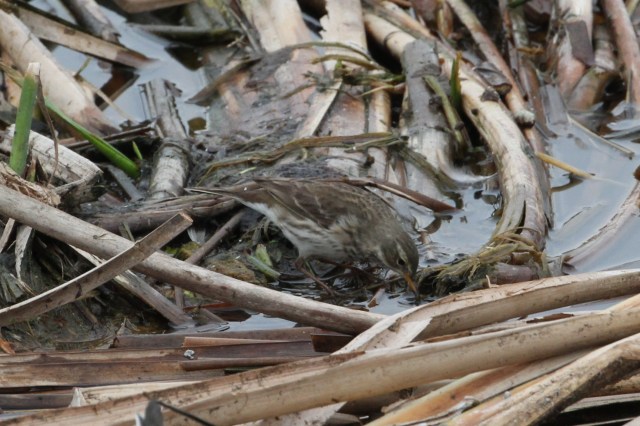
My only photo offering is of this Olive-backed Pipit, Muckleborough Hill – a bit of a ‘creeper’ this one. On the best afternoon for photography my camera developed a malfunction from the morning’s rain, oh well!

IMG_1670

IMG_1640


Isabelline Shrike

DSC00155

Isabelline Shrike, Beeston Common – 11th October, 2015

Today was the NENBC walk around Cley NWT looking for migrants. It was a morning of moderate success, with Brambling and Ring Ouzel (heard only) in Walsey Hills, Short-eared Owl – fresh in off the sea and a couple of Wheatear along East Bank being the highlights. Well that was the morning, the afternoon was decidedly hotter! As no one wanted to go onto the reserve in the afternoon, we’d just decided to go on to ‘pastures new’ when the pager announced an Isabelline Shrike at Beeston Common! We were amongst the first to arrive and enjoyed spanking views. Unfortunately I’d only got my compact camera with me, so had to be content with a few quick digipics.

DSC00113

DSC00124

DSC00127

The day ended with a quick whizz along to Sheringham Golf Course, for a Pallas’s Warbler!

Hortobágy Highlights

DSC01573

Cranes flying to roost – Hortobagy Fish Ponds

We’ve spent the last few days in the wonderful Hortobagy area of Hungary, close to the Romanian border. The whole area is an immense plain with steppes, shallow marshland and fishponds, threaded through with wooded river valleys. It’s a birders paradise, with a range of species typical of the remnant eastern European steppes, and raptors everywhere. In autumn, over 70,000 Cranes gather,  making this one of Europe’s most impressive birding spectacles. (Postscript – this year’s count looks like being closer to 100,000!)

We flew with Wizz Air, on their recently established route from Luton to Debrecen, hired a car from Hertz – there are no ‘on airport’ providers currently operating and stayed at the Bibic Eco Lodge (English version of the website coming soon!) in Balmazujvaros. The Lodge, which has only opened in the last few months, provides an excellent standard of accommodation and meals. Our hosts Tibor and his wife speak fluent English, are knowledgeable birders and could not have been more helpful or friendly. The Lodge provides an excellent secure, comfortable and relaxing birding base – perfectly located to explore the Hortobagy.

Although the primary objective of the trip was to experience the spectacular Crane migration, we did see 116 species in our four day stay, including two Western Palearctic ticks – Saker Falcon & Eastern Imperial Eagle, along with a supporting cast, which included: Lesser White-fronted & Bean Goose, White-tailed Eagle, Pallid Harrier, Red-footed Falcon, Long-legged Buzzard, Great Bustard, Ferruginous Duck, Whiskered Tern, Caspian Gull, Red-throated Pipit, Moustached Warbler, Penduline Tit & Syrian Woodpecker!

Here are a few photos to whet your appetite!

First stop was for the Long-eared Owl roost near the town park. They get up to 300 birds in winter – we only saw 22!

IMG_9255

First of our two Western Pal. ‘ticks’, Saker Falcon – one, of a couple of pairs we saw

IMG_8813

This is their food source, Suslik – a sort of Ground Squirrel. Abundant on the dry puszta

IMG_8765

Common Buzzard abound but this was the only Long-legged Buzzard we came across

IMG_8786

Red-backed Shrike were seen in reasonable numbers throughout the Hortobagy – all juveniles

IMG_8828

Hen Harrier are a regular winter visitor, we saw a couple of ‘ring-tails’ and this fine male hunting over arable fields near Nadudvar

IMG_9072

We were lucky enough to find this Pallid Harrier near the Hortobagy Fish Ponds

IMG_8861

On our second day with Jozsef we started on the puszta, looking for Dotterel, which gather here to moult

IMG_9121

Along with a few Stone Curlew – both species are very difficult to find on the vast expanses of grassland. These were two of six we located.

IMG_9129

In the afternoon our expert guide found us our second target raptor species of the tour – a 3rd/4th year Eastern Imperial Eagle

IMG_9144

and here, being over-flown by Cranes

IMG_9169

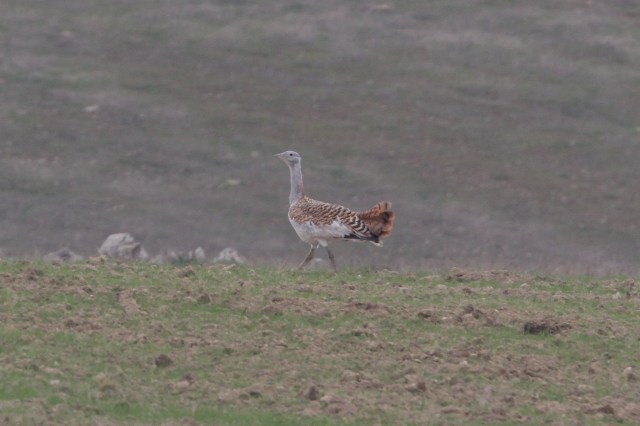
Another highlight of our trip were Great Bustard – not seen since a trip to Extremadura, Spain nearly twenty years ago. Here are some of the sixteen birds present in this remote arable location.

IMG_9091

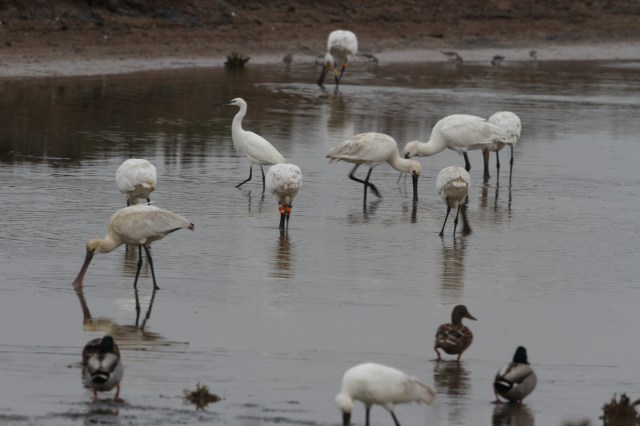
There are plenty of birds to be found in and around the huge complex of fish ponds – some of which have public access (provided you obtain a permit) but most can only be visited in the company of a guide. Spoonbill, Egret and Heron sp. are numerous but this was the only Purple Heron we came across

IMG_9348

Both Bearded and Penduline Tit are common in the vast reed beds which surround the fish ponds

IMG_9327

IMG_9211

Other specialities include, Pygmy Cormorant

IMG_9423

Whiskered Tern

IMG_9431

and Moustached Warbler

IMG_9441

We were fortunate that, on the day before our arrival, 120 Lesser White-fronted Geese also arrived, for their all too brief stop-over on the hortobagy, before moving on to winter in Northern Greece. We caught up with them on the Hortobagy Fish Ponds

DSC01528

We also found the first returning Bean Goose (rossicus) of the autumn and this flock of regular White-fronted Geese

IMG_9379

Staying at the fish ponds until dusk, to watch the thousands of Cranes arrive to roost, was a most memorable highlight of our trip

IMG_9479

They were not alone though, one of several patrolling White-tailed Eagle

IMG_8933

We would never have been able to find/see many of these excellent birds if it weren’t for the great organisation of Janos at Saker Tours and, in particular, our expert and hard-working guide, Jozsef. Thank you to everyone who made our brief trip such a pleasant and rewarding one – we will be back!

Sunset over the Hortobagy

IMG_9522


Historic Churches of Norfolk – Route 15

It seems an age since we did route 15, at the end of June. The route, which started and finished at Acle station, was a reasonably challenging 45 miles in total and filled in the ‘missing piece’ to complete the whole of the north east of the county, from Wells in the west right round the coast to Gt Yarmouth and south to an ‘east – west’ line through Norwich.
The Route:

UK_runners__walkers_and_cyclists_-_map_your_routes 2

The Churches:

All Saints Billockby, St Margaret Burgh St Margaret, St Mary Burgh St Mary, St George Rollesby, St Peter Clippesby, St Edmund Thurne, St Peter Repps, St Mary Martham, All Saints Horsey, St Mary West Somerton, Holy Trinity & All Saints Winterton, St Mary the Virgin Hemsby, St Michael Ormesby St Michael, St Margaret Ormesby St Margaret, Holy Trinity Caister, St Edmund West Caister, All Saints Filby, St Mary Thrigby, St Peter & St Paul Mautby, St Peter & St Paul Runham and St Andrew Stokesby

The Photos:

All Saints, Billockby

All Saints Billockby

St Margaret, Burgh St Margaret 

St Margaret Burgh St Margaret

St Mary, Burgh St Mary

St Mary Burgh St Mary

St George, Rollesby

St George Rollesby

St Peter, Clippesby – window detail

St Peter Clippesby

St Edmund the King Martyr, Thurne

St Edmund the King Martyr Thurne

St Peter, Repps

St Peter Repps

Sundial detail

St Peter Repps

St Mary, Martham

St Mary Martham

All Saints, Horsey

All Saints Horsey

Interior – All Saints

All Saints Horsey

St Mary, West Somerton

St Mary West Somerton

Holy Trinity & All Saints, Winterton – interior

Holy Trinity & All Saints Winterton

St Mary the Virgin, Hemsby

St Mary the Virgin Hemsby

St Michael, Ormesby St Michael

St Michael Ormesby St Michael

A modern day ‘Georgia and the Dragon’, St Margaret, Ormsby St Margaret

St Margaret Ormesby St Margaret

Holy Trinity, Caister

Holy Trinity Caister

St Edmund (new), West Caister

St Edmund West Caister

All Saints, Filby

All Saints Filby

Detail of painted rood screen

All Saints Filby

St Mary, Thrigby

St Mary Thrigby

St Peter & St Paul, Mautby

St Peter & St Paul Mautby

St Peter & St Paul, Runham

St Peter & St Paul Runham

St Andrew, Stokesby

St Andrew Stokesby

and by the end, dead? –  well not quite..

St Andrew Stokesby


Birding Southern Spain – 2015

IMG_8081

Griffon Vulture on the cliffs above Bolonia

We spent the first week of September on one of our regular birding trips to Southern Spain – the principal purpose being to observe, at close quarters, the raptor migration, for which this part of Spain is famous. We flew from Stansted to Sevilla, with RyanAir (more inconvenient now the cheap airlines seem to have abandoned Jerez!), rented a villa on the outskirts of Tarifa and hired a car from Gold Cars, with their usual ‘no fuss nor frills’ service. As we had a couple more days than we usually take, we were able to visit extra sites including the Grazalema area, the Lagunas de Espera and Benalup – details of all these sites can be found on John Cantelo’s excellent ‘Birding Cadiz’ website. Our trip was timed to coincide with the fabulous festival of the Virgen de la Luz – a separate post will be needed to showcase some the splendid spectacle of the caballeros, who are an integral part of the occasion.

Owing to the weather, raptor passage was light on most days but we did get to see some impressive numbers and amassed an overall total of seventeen species. Storks too were on the move, involving groups of 200+ on several days. Though the vast majority were White there were the occasional Black mixed in. Passerine migration was light, with most regular warbler species being encountered, along with Flycatchers, Wheatears and Stonechats aplenty. There was plenty of tern, wader and wildfowl action but nothing to rival previous years. Bee-eaters were pouring through all week, with rarely an hour going by between groups of a dozen to seventy plus, heading south. The three Shrike species were seen in small numbers. Eleonora’s Falcon, Dartford Warbler and Rock Bunting were additions to the generic list for these autumn excursions.

In addition to the avian interest, there were a few dragonfly and butterfly species to keep us amused.

But first the raptors:

Black Kite

IMG_7917

Booted Eagle – pale phase

IMG_7924

Short-toed Eagle

IMG_7937

Eleonora’s Falcon – one of two seen

IMG_7901

Montagu’s Harrier, female – we saw several on migration as well as the ‘locals’ around La Janda

IMG_7774

Egyptian Vulture – seen most days in small groups containing several youngsters 

IMG_7874

Bonelli’s Eagle – seen around the Lagunas de Espera

IMG_8544

Ruppell’s Griffon Vulture – in the hills around Grazalema (comments on id welcome)

IMG_7987

A random selection of some of the other avian interest, starting with Black Stork:

IMG_7819

Purple Heron – one of several on La Janda

IMG_8136

Black-eared Wheatear – mouth-watering views!

IMG_8206

Corn Bunting – so common there, so scarce now in Norfolk!

IMG_7624

Lesser Short-toed Lark – one of two birds on the Bonanza salt-pans

IMG_8576

White-headed Duck – seen at Lagunas Tarelo and Espera 

IMG_8623

Blue Rock Thrush – cliffs above Bolonia

IMG_8096

Insect interest came in many forms but not all were identified and I stand to be corrected on even those I have dared to label!

Scarlet Darter

IMG_7745

Banded Groundling

IMG_7753

Lesser Emperor

IMG_7751

Copper Demoiselle

IMG_8353

Humming-bird Hawk-moth

IMG_7863

Chameleon – John Cantelo tells me it’s Mediterranean Chameleon (Chamaeleo chamaeleon)
Didn’t even realise that they occur in Spain.

IMG_8627

Finally, two hunters seen on the hills above Tarifa. They look as if they’re only shooting rabbits!

IMG_7883


How Hill

Ruddy Darter, male

Male Ruddy Darter, How Hill

Took my brother and his wife, over from Australia for a few weeks, to How Hill at the weekend to see Toad Hole Cottage and the Secret Garden. I was disappointed not to see Swallowtail butterfly but we did catch up with some interesting dragonflies and damselflies, including possible Willow Emerald.

Azure Damselfly

IMG_7453

Possible Willow Emerald – any comments on id welcome!

IMG_7451

Female Migrant Hawker

IMG_7406

Emerald Damselfly

IMG_7470

Female Common Darter

IMG_7387

Autumn Migration

IMG_7312

Booted Warbler, Gramborough Hill

Autumn migration got off to a good start on the Norfolk coast this weekend, with a reasonably obliging Booted Warbler, which was found late on Saturday morning. As we still had ‘house guests’ from my week-long 60th Birthday Bash, see Aylmerton Nature Diary for the full story, we weren’t able to go for it until late on Sunday afternoon. As we walked towards Gramborough Hill, in the stiffening easterly wind and thickening sea fret, there was a female Wheatear on the grazing meadow fence – surprisingly, my first of the autumn. There was a small group of a dozen or so birders staring into the large clump of bushes when we arrived, apparently the Booted hadn’t been seen for a while but there was a handful of Willow Warblers and an Icterine Warbler, showing periodically. The Icterine appeared almost immediately, but only fleetingly, as it flew between clumps of undergrowth. Eventually the Booted also popped up out of the big clump, flew over to the bramble patch and perched up, before disappearing into cover. It did reappear, low down in brambles, before flying back to the clump of Elder and was lost to view. Several Pied Flycatchers provided a welcome diversion, before they flew off towards the village. I didn’t get to see the Redstart or Wryneck which had also been reported earlier.

Yesterday was ‘duty day’ at Cley NWT. The morning started off well when a Temminck’s Stint was found on Pat’s Pool, together with four Little Stint. Later in the morning I came across a Purple Sandpiper. I saw twenty species of wader during the course of the day but, alas, the reported Terek Sandpiper at Salthouse never made it as far as Cley. Oh well, not a bad day and a pretty good start to autumn migration!

Pied Flycatcher – one of three ‘new arrivals’

IMG_7378

Wood Sandpiper – one of ten reported at Cley on Monday

DSC01258

Distant digiscoped grab-shot of Temminck’s Stint

DSC01310

An early returning Purple Sandpiper – one of twenty wader species seen at Cley on Monday

DSC01298

Chalked Up

IMG_7150

Chalk-hill Blue, Norfolk

I had a spare couple of hours yesterday and, although the weather wasn’t particularly conducive to butterfly hunting, I decided to head down the coast from Cley to the site of an Iron Age Fort and home of one of Norfolk’s scarcer butterflies – Chalk-hill Blue. By the time I arrived the wind had picked up to quite a stiff breeze and the sun was well and truly hidden behind the threatening clouds. Nonetheless, as I dropped down into the moat, I soon disturbed the odd insect, resting down amongst the grass stems. As I slowly made my way to the more sheltered side of the fort their numbers increased, until there was a veritable cloud of the things flying around! My first Chalk-hill Blues in Norfolk, and what a spectacle!

IMG_7140

Keeled Over

Although it wasn’t ideal ‘dragon hunting’ weather this afternoon, I ventured out on to Beeston Common with Andy, in pursuit of Keeled Skimmer. This is a scarce dragonfly in Norfolk, found only at a handful of sites across the county. We hardly saw an insect for the first three quarters of an hour before finally, in a brief spell of sunshine, Andy spotted first a female and then a resting male. Another female appeared and disappeared almost as quickly. The pair stayed long enough to get reasonable record shots. Towards the end of our afternoon session we saw a very obliging  male Emperor at rest.

Talking to Francis Farrow, volunteer guardian of the Common, he said that the Keeled Skimmer were definitely approaching the end of their season. This was a new dragonfly species for me, so I was pleased to see them before they keeled over!

Male, Keeled Skimmer

IMG_7079

IMG_7081

Female Keeled Skimmer

IMG_7086

Male Emperor

IMG_7094

Stunning Sterna

IMG_6508

Adult Roseate Tern, Arnold’s Marsh, Cley

We were pretty quick off the mark yesterday evening when the call came through about a couple of adult Roseate Tern on Arnold’s Marsh, Cley. Unfortunately, by the time we got there, the birds had disappeared and no one else, other than the finders, had seen them either. Oh well! – you win some and you… Anyway, we were on ‘high alert’ this morning in case they were relocated – which they were, at around 10.00. Off we went again but this time, even from East Bank, we could tell by the concentration on the faces of the small assembled crowd, that the birds were still present. Unfortunately, Arnold’s Marsh is never particularly good viewing in the mornings – the birds usually being distant and you are looking into the sun. Any how, there they were, giving reasonable views for fifteen minutes, before they decided to get airborne and disappear across the shingle ridge and out to sea.
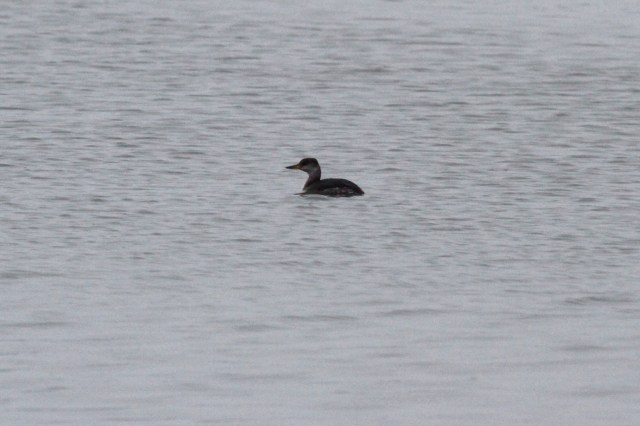
A couple more shots, showing the key features: all dark bill, bright red legs, narrow outer primary wedges, pale mantle and long tail-streamers (alas no pinkish tones to the underparts were discernible) – taken into the sun with plenty of heat-haze for good measure:

IMG_6495

IMG_6480

IMG_6504