Hunter birding draws to a close

Roosting Tawny Frogmouth

One of the few night birds which can be seen in the day is the weird and wonderful Tawny Frogmouth. Despite their large size (wingspan of <30cm) and relatively common status – even in urban settings – their cryptic plumage makes them difficult to find. Yesterday we did another trip round Newcastle, trying unsuccessfully to fill more holes in my Hunter List. At one site, whilst looking for something else, Dan said casually ‘there’s a Tawny Frogmouth up there’! When we looked there were actually three – possibly an adult with young.

We’ve been studying flocks of White-throated Needletail – looking for rarer swifts – but, alas, no luck

We’re now at the end of our stay in NSW and today we fly down to Melbourne to stay with my brother Rob and Gi. It’s been great spending time with Dan and his family, catching up with friends, visiting old and new places and, of course, doing some NSW birding. During our time here we’ve managed to see (or hear) 215 species and moved my Hunter list on with a dozen or so ticks. My all-time Hunter total now stands at 338 – not bad for an occasional tourist! See you in Victoria.

Until the next time….

Night manoeuvres

Record shot of Owlet-nightjar, taken in Queensland in 2014

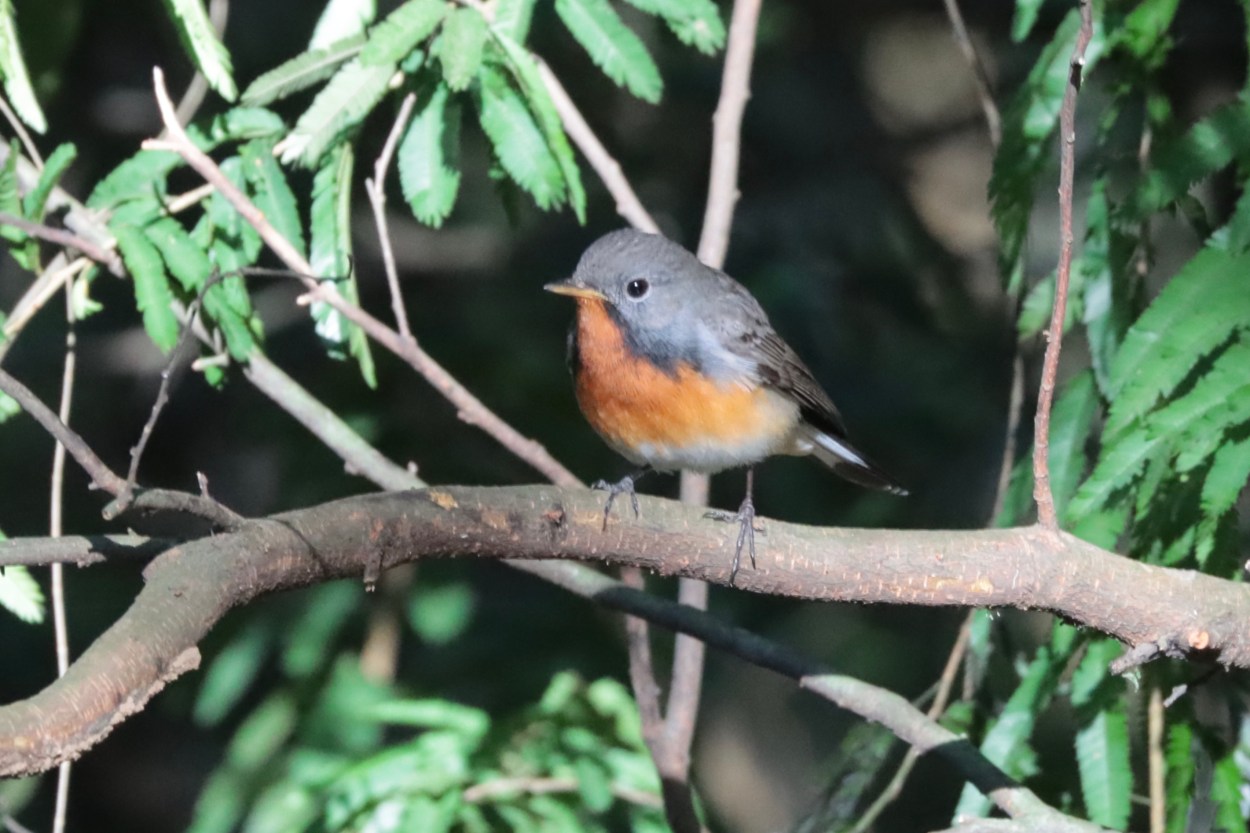
I’ve said it before, night birds in Australia are a nightmare. They rarely emerge until it is proper dark and the forest species often remain hidden deep in cover – their calls being the only evidence of their presence. Every trip to Australia we have undertaken at least one night-time manoeuvre, attempting to see owl or nightjar species – nine times out of ten we fail. Yesterday evening we returned to the Watagans National Park for our third visit this trip, in the hope of connecting with some rainforest species prior to a spot of owl-dipping! We tried several locations for Rose Robin to no avail before pulling up at a promising piece of habitat in the failing light. Dan heard a treecreeper and I saw a bird fly and land tight to the trunk of a near-by gum tree. Assuming it was the bird I lifted my bins only to see our target bird – Rose Robin! Two silent birds flitted through the canopy, giving reasonable views. My first for the Hunter. An hour later it was dark and despite playing a multitude of different calls we only had brief and distant responses from a Masked Owl and Boobook. Returning home along a forest track a bird flushed in front of us – in the headlights it looked like Owlet-nightjar. A response to play-back and a couple more over-head passes confirming the identification. Another Hunter tick – my last previous sighting being in 2014.

Endemic chase comes to an end

Finally – Rockwarbler in the Hunter!

Rockwarbler is New South Wales’ only endemic. It’s a bit of an anomalous species, looking more like an Old World warbler than anything typically Australian. It is only found on sandstone outcrops in central coastal areas of the State. We’ve seen it well on previous trips to the Blue Mountains near Sydney but, despite extensive searching – including on this trip – we’ve never caught up with it in the Hunter. All that changed this morning when another early start took us to the Sugarloaf Mountains for dawn. Half an hour at the Lookout produced nothing and it was beginning to feel like another dip when Dan suggested we move further round the rock escarpment. Within a few minutes first one and then another appeared at very close quarters – the relief was palpable.

a couple more shots of this rather ‘Old World’ looking species

Logrunner – does what it says on the can

Record shot of Australian Logrunner – near Buladelah. A Hunter tick!

We were up again at 4.00am for an early start in the rainforest. The first couple of sites produced some interesting birds but not the elusive ‘Hunter tick’ we were hoping for. Eventually, after a walk through ‘leech country’, near Buladelah – I picked up three in my sandals! – we struck gold. The well-named Australian Logrunner was running around on a mossy log in the dark depths of the forest. We eventually saw a couple of birds well, but photographing them at 1/5th second not surprisingly produced record shots only. Our second prize came in the form of Varied Triller. This is a species we’ve seen well before in Queensland but here, at Mungo Brush, it is approaching it’s southern limits. We saw three birds – probably a pair with a youngster in tow. On the way home a Square-tailed Kite obligingly drifted across the Pacific Highway – my third Hunter tick of the day – bringing my tally to a dozen for the trip so far!

Varied Triller – grab shot

NYDBC – Down-under style

Highlight of my 2022 NYDBC – an adult Powerful Owl in Newcastle, Australia

Nowadays I normally spend New Year’s Day in the NENBC area, doing the club Birding Challenge. The challenge being to get out of bed, get birding and get my New Year’s list off to a good start. This year it’s been a bit different, as we’re down-under in Australia, visiting family. In a gesture of NENBC solidarity I decided to generally stick as close to the ‘rules’ as possible but, since celebrations on New Year’s Eve also involved Dan’s 40th birthday shindig, I opted for a later evening start – to coincide with UK time – followed by a morning session on the 2nd. In total we birded for about six hours, all of which was spent within the Newcastle LGA – essentially birding within the city limits. By the end of the evening session we’d seen around 65 species – this morning we managed to push that total to 106. This involved more ‘heard only’ ticks than I’m used to but Australian bush birding is like that. If I wasn’t sure, after listening to the audio track, then I didn’t count it. That probably cost me another dozen species. Most of the birds were the regular stuff, which we’ve been seeing since our arrival, but I did manage to add a couple of trip ticks. Unquestionably the bird(s) ‘of the day’ was the adult and young Powerful Owl we found this morning deep in a damp gully in Black Butt Reserve. It’s only the third time I’ve seen these monster birds – which mainly feed on Possum – once, about twelve years ago, in very nearly the same spot and once in the ‘go to’ location for UK birders – the Sydney Royal Botanic Garden. Tomorrow we’re off early to try to add a couple more rainforest species to my Hunter list.

The juvenile – in better light

Closing out 2021

Adult male Regent Honeyeaters – there are only an estimate 250 – 300 wild birds left in the world

On Thursday we had a big day out in the Hunter. We had left the house by 05.00 and didn’t return until nearly 11.00pm – visiting some of the most far-flung parts of the Hunter Bird Observers Club recording area. Our collective team efforts did not go unrewarded, with an impressive seven Hunter ticks – bringing my all-time total to 332. Most of the birds were either species on the extreme western edge of their range or birds with a particular habitat niche. Either way a lot of travelling was involved between ticks.

Yesterday was the Big Day – Dan’s 40th – but we began it in customary style but visiting woodlands in the Kurri Kurri / Cessnock area, to look for Regent Honeyeater. There are perhaps only around 250 – 300 wild birds left in the world and although there is an active captive breeding & release programme, this prince amongst honeyeaters remains on the brink of extinction. Thanks to a local birding friend they were reasonably easily located and safely observed. We saw at least half a dozen birds, including a fully fledged youngster and one of the two adult males recently fitted with a satellite tracker – in the hope that their still unknown wintering grounds might be located & protected.

By 3.00pm the birthday party was in full swing. It was a looong time before we could see the New Year in and fall into bed. A Happy 2022 to one and all.

One of three White-winged Fairy-wren found in the middle of HBOC ‘nowhere’ – a most unexpected addition to the list

GBT – a case of diversity

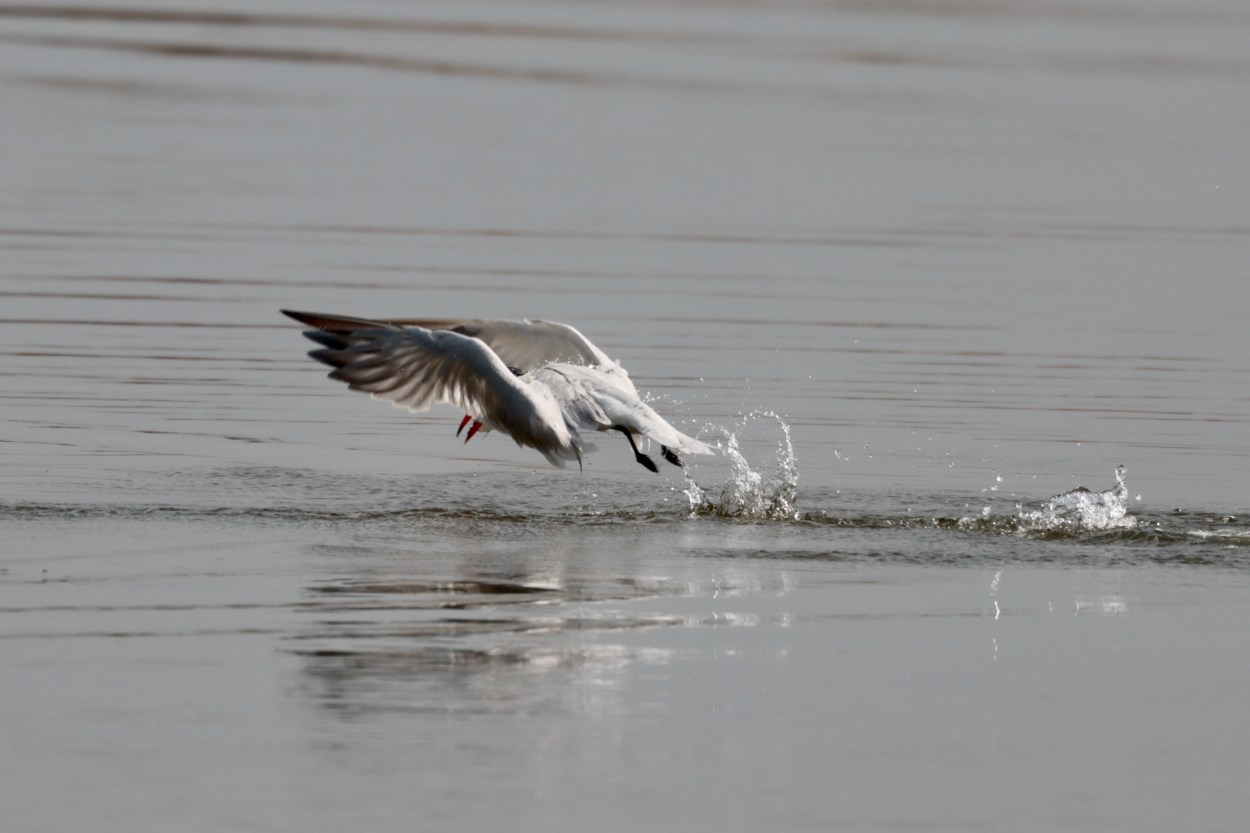
Both species of Gull-billed Tern – Common (front) & Australian – at Stockton Sand-spit

Last time we were out here I managed to add a recent ‘split’ to my Aussie & Hunter list – Australian Gull-billed Tern, having been separated from Common Gull-billed Tern (Birdlife International). Yesterday we made our first visit to Stockton Sand-spit, in search of some waders. Although a number of the speciality waders were absent we still managed to add seven to the list. In amongst the godwit flock – mostly Bar-tailed with a few Black-tailed – were two terns. Turned out (pardon the pun) that they were one of each of the Gull-billed variety, with all of the distinguishing features being readily observable at close range. The Australian version being larger, paler backed, with distinct ‘highway-mans’ mask and symmetrical upper and lower mandible profile. Actually they look like two different birds!

Two shots, showing the open wing – first of the Australian, second the Common (which is an annual rarity in the Hunter)

Local Hunter birding

Banded Lapwing – best of the Hunter waders so far

Our first day free from covid restrictions was spent doing a circuit of the familiar Newcastle birding hotspots. What became increasingly apparent – due to the prevailing wet weather conditions, linked to El Nino, and changes in salinity on Hexham Swamp – is that there are very few waders about. Whereas, on previous trips, we may have seen hundreds of up to a dozen varieties, this time we’ve hardly seen any. Still, we did see some nice stuff, including Banded Lapwing – a specialist of the inland ‘lawn-turf’ fields and a more recent heron coloniser – the huge Jabiru or Black-necked Stork.

Jabiru – a recent colonist – benefiting from the habitat changes in the Hunter

Aussie Christmas

Wedgie – one of three eagle species seen from Dan’s Newcastle house

We’re in Australia to spend Christmas & New Year with Dan, Morgan & the Boys. Despite all the Omnicron uncertainty of the past few weeks we did manage to get a relatively trouble-free flight with Cathay Pacific on Tuesday, arriving 30 hours after departing from St. Neots. It did involve a lot of additional paper-work, pre-flight PCR’s, etc and it’s a long time to wear a face mask – but it does prove it’s possible! Having gone to bed at around midnight (in Australia) we were up early to get our first ‘test to release’ PCR, with results expected within 24-48 hours – certainly in plenty of time for us to enjoy a family Christmas meal in a Newcastle restaurant. As I write this, four days after the test, I’ve just got my results through – NEGATIVE! and an end to self-isolation. Although our Christmas dinner was a couple of sausage rolls, it’s been lovely to be here with the kids and we look forward to New Year’s Eve – celebrating Dan’s 40th. Still, on the birding front, it’s not been at all bad. Living literally across the street from a RAMSAR wetland has it’s advantages and we’ve manage to see / hear over 70 species so far – including three eagle species. Last night we did an impromptu survey of birds returning to the Wetlands Centre to roost. We counted over a thousand birds – mostly Great, Intermediate & Cattle Egret, Australian White Ibis, Royal Spoonbill and the smaller cormorants. Today, with our new-found freedom, we’re off in pursuit of my first Hunter tick!

Cornwall concluded

Semipalmated Sandpiper – seen here with Dunlin – on the Hayle estuary

With constant sunshine and unseasonably warm weather we’ve had a fabulous week birding here in the Cornish valleys. Although migrant passerines have been very few and far between, with the help of an occasional sea-watch and spending time studying the comings and goings on the Hayle estuary, we’ve managed to accumulate a reasonable list. Personally I’ve seen 109 species since we arrived, missing only a couple of things seen by other members of our party. The undoubted highlight has been daily views of the Semipalmated Sandpiper, but raptors have also been a real feature including: Kestrel, Sparrowhawk, Peregrine, Merlin, Buzzard, Hen Harrier and Short-eared Owl. A second Siberian Chiffchaff – yesterday at Porthgwarra – with a late Yellow Wagtail, a couple of Black Redstart and that obliging Snow Bunting making for a reasonable supporting cast of ‘bush birds’. All three egrets at Drift, providing a backdrop for the Black-necked Grebe, also deserve a mention. There are few better places to spend an autumn week birding – we’ll be back.

Our second Sibe Chiffchaff of the week
A nice late Yellow Wagtail in the early morning sun at Land’s End
One of at least four Short-eared Owl at a site near the airport
A lone Merlin looking for passing migrants, which – apart from Meadow Pipits – where very thin on the ground