Day 21- Creeks & Canyons

DSC02196

View of ‘Main Street’, Tombstone

We decided to take an early morning stroll around Tombstone before heading off birding. There were few people around and the low angle of the sun added to the atmosphere of this quintessential ‘wild west’ town. After a breakfast of coffee and ‘bear claws’, at the Charleston bridge – which spans the San Pedro River, we headed for Escapule Wash and then the San Pedro House reserve. At the latter we enjoyed a delightful walk, with plenty of birding interest. After a snack lunch, over-looking the bird feeders, we went to Miller Canyon, stopping off at Beatty’s Guest Ranch to view their hummingbird feeders. Nothing new species-wise but a pleasant walk all the same.

Gilded Flicker a new addition to our GAMRAT list – restricted to Arizona and south Nevada

IMG_9601

Broad-billed Hummingbird – male, at Beatty’s Guest Ranch feeders this afternoon

IMG_9638

Day 20 – Snakes on the plain

IMG_9395

Western Diamondback Rattlesnake – a (too) close encounter!

Todays excitement came in the form of two close encounters with snakes! The first was on the dirt road between Cochise College and Double Adobe – possibly a Coachwhip. The second was almost a step too far for Jane as she, unknowingly, came within a few feet of a ‘rattler’ – probably a Western Diamondback! Any American snake experts reading this blog, who can specifically identify the photos, please do leave a comment. Away from  Herpetology, the birding in Cave Creek Canyon first thing this morning was excellent –  we heard Elegant Trogon, our target bird, on this our third attempt, but failed to see it.  Our best find was a Northern Pygmy Owl. At Whitewater Draw wildlife refuge, owls again took star billing with a nesting pair of Great Horned Owl and their three youngsters. They were flooding the fields at this latter site, which proved attractive to ducks, waders and other water birds – a rare occurrence in arid Arizona. Tonight we are staying at The Sagebrush Inn, in Tombstone – one-time home of Wyatt Earp and Doc Holliday!

Possible Coachwhip snake

IMG_9269

First of two owl species seen today – Northern Pygmy Owl (with prey), Cave Creek Canyon

IMG_9204

Grab shot of three young Great Horned Owl, Whitewater Draw wildlife refuge

IMG_9342

Our over-night accommodation..

IMG_0712

Day 19 – Trio Tinto

IMG_9149

Undoubtably todays star bird – the rare and rather striking Slate-throated Redstart

We spent the whole day birding the Chiricahua Mountains, visiting most of the significant sites around the Portal loop. We saw a great range of birds typical to this area of south east Arizona – a number of which have only a toe-hold in the USA, including Mexican Chickadee, Yellow-eyed Junco and Hepatic Tanager. But the best birds today all seemed to have the colour red in common. First we saw Painted Redstart, at the start of the Cave Creek South arm trail. Further up the trail we came across Red-faced Warbler and this afternoon – much against the book, since it is considered to be a ‘morning bird’, the well-twitched US rarity Slate-throated Redstart.

Grab shot of another of the red brigade – Red-faced Warbler

IMG_8980

Finally, the last of the ‘gang of three’ – Painted Redstart

IMG_8849

Day 18 – Through New Mexico to Arizona

IMG_8571

Lark Bunting – one of the species seen better in Arizona than Texas

We left El Paso early and, soon after, crossed the State line from Texas into New Mexico. Two hundred miles later and we were in Arizona for an outstanding afternoons birding around Portal, in the foothills of the Chiricahua Mountains. We added a few ticks and saw some species we’d already seen in Texas, only much better. A truly memorable end to the day came when we were invited by Maya Decker to enjoy her yard birds – which included Magnificent Hummingbird, an America tick, a flock of 15 Lazuli Bunting and a supporting cast of  Hummers, Orioles, Sparrows and Towhee! Supper at the Portal Stores & Cafe was a perfect conclusion to a great first day in South East Arizona.
Unfortunately the WiFi is too weak to upload any more photos at the moment – more to come later!

Post-script – now, with better internet, a couple more photos.

First of two American ‘ticks’ – Harris’s Sparrow

IMG_8668

then Magnificent Hummingbird in Maya Decker’s back-yard

IMG_8763

The quaint Portal Stores & Cafe

IMG_0705


Day 17 – Doing the numbers

IMG_8461

Gambel’s Quail – seen at the bird-blind, Franklin Mountains State Park

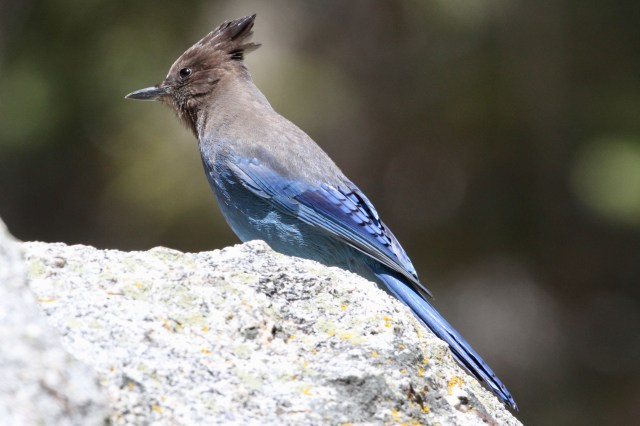
Today we said goodbye to Jake at El Paso airport and said hello to Bob & Sue – a very smooth change-over. This pretty much marked the end of our Texas odyssey – the first leg of our Great American Birding RoAd Trip. We’d started the day with an early morning trip back to Davis Mountains State Park in an attempt to find Montezuma Quail. We heard several calling along Skyline Road but, predictably, failed to see any.  After dropping Jake off we did spend the afternoon easing Bob & Sue back into American birding, by visiting Franklin Mountains State Park. This proved reasonably productive, with twenty or so commoner species and two much needed additions to the Texas list – Gambel’s Quail and Steller’s Jay (interior west race).

Steller’s Jay (interior west race) – West Cottonwood Springs Canyon. A much welcomed addition to my Texas list

IMG_8519

So turning to the numbers – in the 16 days we’ve actually birded in Texas, our State list finished on a provisional 310 species – with a couple still to check, we’ve travelled over 2,650 miles (Texas is a pretty big state!) and my all-time American List has risen to 403.

Much of the credit for such a good list goes to Jake who did a great deal of research before we set off and whose keen powers of observation and persistence produced many of the best birds. Jake, we’ll surely miss you on our continuing journey. It was a pleasure sharing so many good birding moments with you. Travel safe.

As a reminder of the good times, here are a few of our trip ‘catch phrases’ picked upon from a variety of characters met along the way:

‘They’re killing Americans in El Paso’

‘I hear they do pretty good chicken wings in this place’

‘Chestnut-sided Warbler – went thata way’

‘Gotta TV here John’

Till the next time…

Day 16 – Desert delights

IMG_0698 2

The remarkable Carolyn Ohl-Johnson and her equally remarkable Christmas Mountain oasis reserve

Today was our last full days birding with Jake in Texas, before driving to El Paso to drop him at the airport and, hopefully picking up our long-time birding friends Bob & Sue. We’d read on the internet before we travelled about the amazing desert oasis reserve, created by Carolyn Ohl-Johnson, at Christmas Mountain. The reserve lies on the north west edge of the Chisos Mountains and was first created in 1996. It is a magnet for migrating birds as well as home to some very special hummers – Lucifer Hummingbird. It’s not an easy place to find, the final four miles being up a rocky dirt track and you have to book well in advance with Carolyn – but the effort is worth it. Our visit coincided with their ‘Big Sit’ and by the time we came to leave they were up to 43 species – shooting for 50. It didn’t take us long watching the feeders to glimpse our first Lucifer, as it darted in to feed, but it took us another couple of hours to manage even a grab shot. We left Carolyn’s oasis, with several new additional species, and headed for Fort Davis and the splendid ‘old colonial’ Hotel Limpia. An afternoon of birding brought us, what I suspect will be, one of the highlights of our Texas tour – a mini twitch to find a superb Lewis’s Woodpecker. This north-west and central States species winters in small numbers as far south as Texas but this individual kindly decided to wait around for us to see it.

The star bird of Christmas Mountain, Lucifer Hummingbird – a rare breeding Mexican overshoot, with it’s distinctive iridescent purple frilled throat-patch

IMG_8223

Other good birds seen at the oasis included Black-headed Grosbeak

IMG_8304

In the afternoon a ‘mini twitch’ delivered us one of our Texas highlights – Lewis’s Woodpecker, at Prude Ranch

IMG_8356

A touch of ‘old colonial’ luxury, in marked contrast to our usual motel accommodation, the Hotel Limpia at Fort Davis – ending our Texas leg of GABRAT in style!

IMG_0701

Day 15 – Chisos Mountains

IMG_7807

Colima Warbler the rarest breeding warbler in the USA – Boot Spring Canyon, Big Bend

Today was dedicated to birding in the Chisos Mountains, looking for a handful of scarce, high elevation, species including the rarest breeding warbler in the USA – Colima Warbler. The highest point in the range is Emory Peak at 7,825 ft and the Pinnacle trail, which we took, takes you over 6,000ft. In total we did 20 kilometres, leaving at 07.30 and arriving back at base camp ten hours later. Fortunately the weather was cloudy and relatively cool – ideal for day-long birding. We had heard stories of people setting off at  3.00am to avoid the worst of the mid-day sun, but leaving in day-light meant we could bird all the way up the mountain. Without realising it we’d already passed through one of the best areas for the warbler by the time we reached the rim of the plateau. We carried on to Boot Spring Canyon, another favoured location and, after a couple of hours fruitless searching, managed to located a single bird foraging in the canopy of a large Oak tree at the head of the canyon. This sighting made all the hard work of a long, and at times, difficult ascent all worth while. On our way down we again passed through the current favoured area and had more great views.

Amongst the many goods birds we saw was this Blue-throated Hummingbird

IMG_7951

Day 14 – transition day

IMG_8257

Acorn Woodpecker – outside our cottage, Chisos Mountain Lodge

Today we travelled west from Concan on the Edwards Plateau to the Chisos Mountains is the far west of Texas, close to the Mexican border, in a bend of the Rio Grande. Most of the eight hour drive was spent crossing the Chihuahuan Desert. We arrived at Big Bend National Park by mid-afternoon and birded a couple of sites before checking-in to our cottage at the Chisos Mountain Lodges. A bit of local birding then before dinner and turning in for the night, in preparation for our big day in the Chisos Mountains. On our journey over we got held up for twenty minutes whilst they concluded another pre-race heat of the Big Bend Open Road Race between Sanderson to Fort Stockton – apparently one of the most prestigious saloon car time trials in the USA.

Say’s Phoebe, in the grounds of the Lodge

IMG_8096

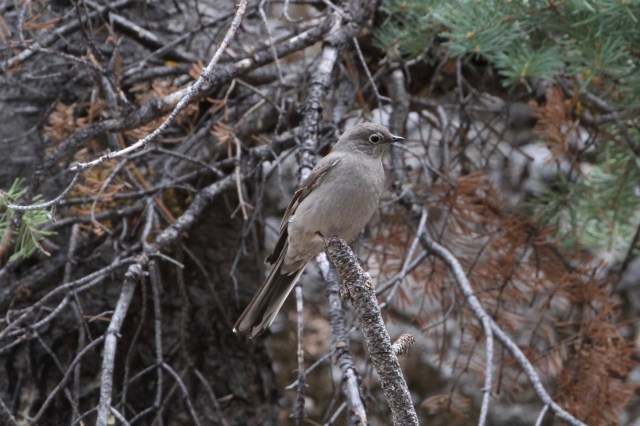
Another speciality of the local area – Townsend’s Solitaire

IMG_8086

One of the 160 competitors, completing a preliminary heat in the Big Bend Open Road Race

IMG_0677

Day 13 – after the storm

P1120382 2

Driving conditions during todays thunderstorm

We had tremendous thunderstorms this afternoon travelling back from Lost Maples State Natural Area, our first birding stop of the day. We had an interesting walk up the canyon but saw nothing different from South Llano. After the rain we did managed to get out around the campsite and had some excellent birding, including three new species. Tomorrow we’re heading 350 miles west to Big Bend and hopefully a hat full of new birds and some pretty special scenery.

After yesterdays two female Lazuli Bunting, it was good to find a male in our own ‘back yard’ this afternoon

IMG_7366

Ringed Kingfisher on the River Frio, behind our cabin (photo courtesy of Jake)

IMG_7199

We seen several species of snake since we started our trip, though we’ve only managed to positively identify Rat Snake and this, possible, Water Moccasin  – one of the more deadly species

IMG_7293

Day 12 – South Llano

IMG_7055

Golden-cheeked Warbler – an endangered species which only breeds in Central Texas

We spent the day, up in the hills eighty miles north of Neal’s Lodge, at the State Park of South Llano River. We walked the trails in the morning – too hot with too little water, but some good birding all the same! We quickly got to grips with the two key species, Black-capped Vireo and Golden-cheeked Warbler and a supporting cast which included Scott’s Oriole, two more vireos – Hutton’s & Bell’s, Woodhouse’s Scrub Jay, Bewick’s Wren and Pine Siskin. We spent the afternoon relaxing in the bird hides and watching a variety of species, the highlight of which were two female Lazuli Buntings.

Black-capped Vireo – the other range-restricted target species

IMG_7079

Scott’s Oriole – another America tick for me

IMG_7089

Woodhouse’s Scrub-Jay – a comparatively recent split from Western Scrub-Jay

IMG_7206

Away from birding, Jake and I spotted this sign in a local South Texas town – the perfect combination! It was, of course, a drive-thru

image1