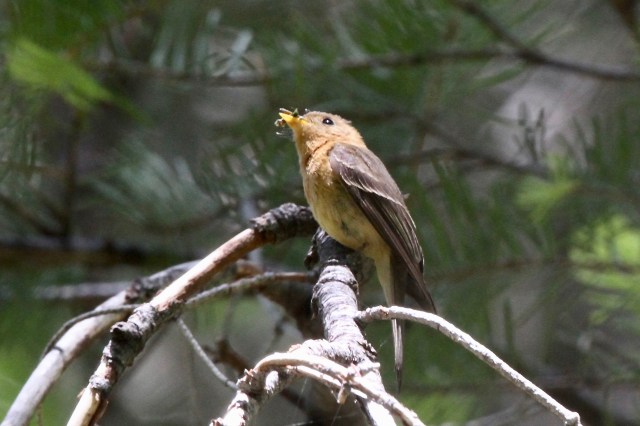
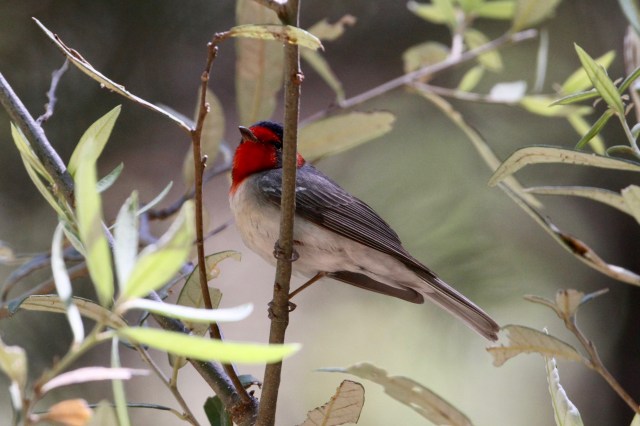
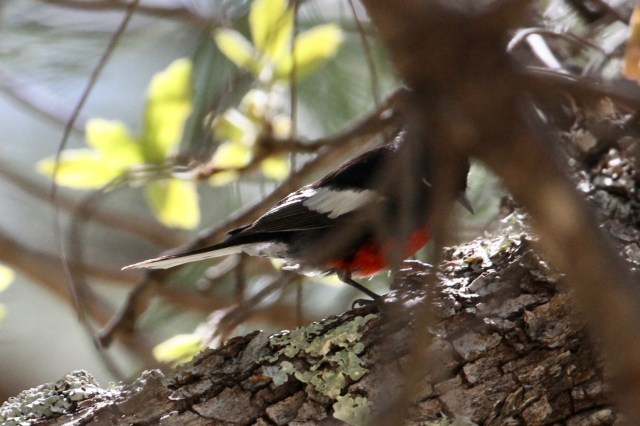
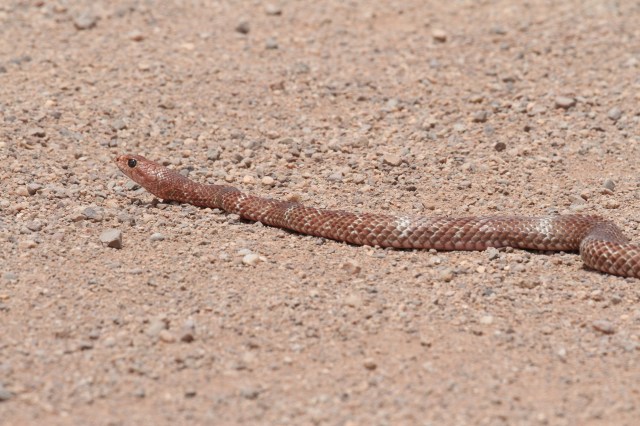
Day 5 – transition day

IMG_5334

I forgot to feature this bird in yesterdays post – Roseate Spoonbill. Quite the Bobby dazzler

Today was a transition day, moving south from the Anahuac / High Island area down towards the Rio Grande, stopping overnight at Port Aransas. We birded up until lunchtime, then took the 200 mile, scenically challenging, drive to our hotel. First stop this morning was the coastal reserve at Bolivar Flats. Plenty of shore birds but nothing new over yesterday, except the rather surprising addition of Glaucous Gull. There’d been an Iceland Gull reported at this location over the past week but a birder, staying in the same hotel as us at Winnie, found the Glaucous whilst looking for the Iceland! It seems very odd to see this species, which I associate with Norfolk in mid-winter, straying as far south as the Gulf of Mexico. We caught the ferry to Galveston and checked out a couple of sites – one being Corp Woods which we visited on our last trip to Texas in 2009, the other being Lafitte’s Cove. We did add a couple of new species but generally it was pretty unexceptional.

Clapper Rail in the early morning sun – West Frenchtown Road, Bolivar Flats

IMG_5368

Spotted Sandpiper, taken at the same location – like our own Common Sandpiper, only with spots!

IMG_5351

Perhaps the biggest surprise of the trip so far, Glaucous Gull – found by a birder looking for the reported Iceland Gull – Bolivar Flats. Record shots only

IMG_5388

Day 4 – Anahuac & Rollover Pass

IMG_4903

The generally elusive Sedge Wren at Anahuac National Wildlife Refuge

We spent a tremendous morning driving the Anahuac National Wildlife Refuge’s, Shoveler Pond loop – two and a half miles through reed-bed, ponds and wet-land. First stop was The Willows, an area of scrub which is known to be good for migrants. We had a few there including Yellow-rumped (Myrtle) Warbler, Orchard Oriole, Common Yellowthroat, Painted Bunting and Great Crested Flycatcher. We also caught up with the generally elusive Sedge Wren. Then on to the other pull-ins along the route, adding numerous fresh-water wader and wildfowl species. Top birds were another couple of difficult to see species – Virginia Rail and Marsh Wren. After lunch we went to the beach, Rollover Pass, to be precise – a great place for shore birds. Here we had seven species of tern and a hat-full of saltwater waders. Our final stop was back at the woods and ‘yards’ of High Island where, on our way through to the coast, we had lunch whilst watching Hooded Warbler, Ovenbird, Brown Thrasher and, best of all – the elusive Swainson’s Warbler!

Just one of the array of wildfowl, heron  and wader species – Least Bittern

IMG_5001

Another difficult to see bird is Seaside Sparrow – seen at Tuna Road

IMG_5286

But the ‘stand-out’ species of the day – found by our resident ‘birding pursuivant’ Jake, was Swainson’s Warbler – Hooks Wood. Record shot!

IMG_5169

Day 3 – High Island

IMG_4939

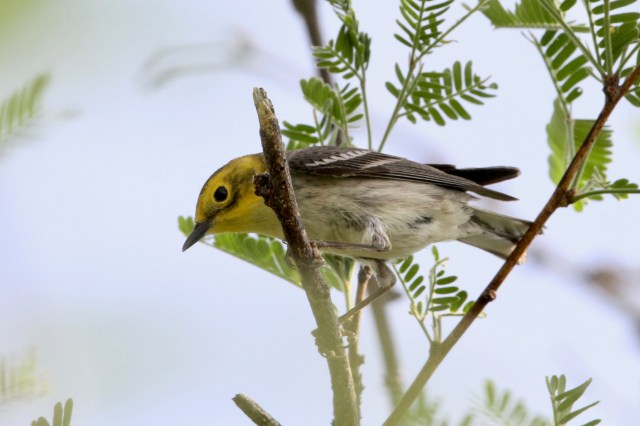
We were particularly looking for warblers today and although it was a relatively ‘slow day’ at Boy Scout Wood, we did manage to find a few, including this fine specimen of  Hooded Warbler. Photo courtesy of Jake

Our first full days birding in Texas since our departure from the UK. We spent around eight hours watching migrants in a few small blocks of woodland and yards on High Island, starting and finishing with more exploration of Anahuac National Wildlife Refuge. We finished the day on a list just shy of a hundred – not a bad start for our GABRAT.

Other nice birds for the day included this handsome Brown Thrasher

IMG_4817

And this Upland Sandpiper – strange looking birds!

IMG_4768 2

Day 2 – GABRAT

IMG_4333

A superb Bald Eagle, near the public boat-ramp at Anahuac, this evening

Most of Day 2 of our Great American Birding RoAd Trip was taken up with flying from Manchester to Texas – a rather turbulent experience for most of the four hours from the Canadian border to Houston! We arrived at about two thirty and finally departed the airport, in our brand new Hyundai Tucson hire car, for Winnie our base for the next three days, an hour or so later. We did manage to do a bit of birding on route, around Anahuac, clocking-up a total of 37 species, including a superb fly-by Bald Eagle.

We saw a few nice waders around Anahuac, including this nice Killdeer

IMG_4312


Great American Birding RoAd Trip

Summer Tanager

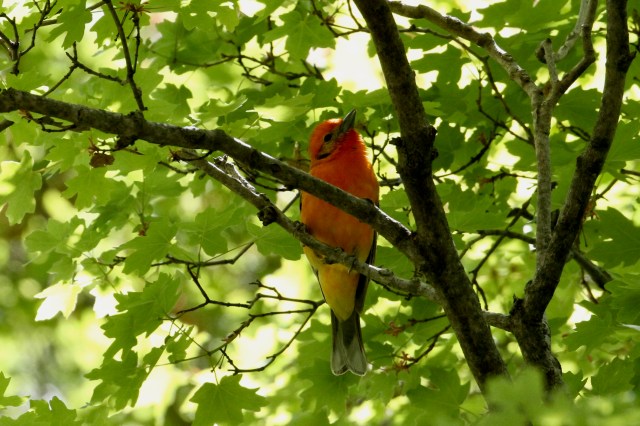
A taste of things to come – Summer Tanager, Lost Maples, Texas 2009

Jane and I depart shortly on our two month long Great American Birding RoAd Trip (or GABRAT for short!), following the birds on their Spring migration – travelling from east to west and south to north. We arrive in Houston, Texas mid-April, travel down the Gulf of Mexico and then east along the Rio Grande, Neal’s Lodge to Big Bend, then on to El Paso via Fort Davis. On this first leg we’ll be joined by our youngest son and keen birder Jake. At El Paso we meet up with our long-time birding friends, Bob & Sue, for a tour of south-east Arizona, before heading north to the Grand Canyon and then to Vegas. A few days there then it’s on to Death Valley, Yosemite and over to the coast at Monterey, in the hope of catching a pelagic. North to Point Reyes, where we say goodbye to our friends, before heading on into Oregon – Klamath, Crater Lake, and the sites around Bend. Our final adventure, after we meet up with my brother and his wife from Australia, is a brief tour of north-west Washington State, including a ‘mini pelagic’ ferry trip to Vancouver Island. Finally departing from Seattle for home, sometime in mid-June. Hopefully, I’ll be publishing regular blog-posts, capturing the birding highlights, as we follow the awesome spectacle of American Spring bird migration…

Birds of Italy

Marble Parrot table-top, in the Pitti Palace Royal Apartments

Despite the fact that this was an entirely cultural trip, I even left my binoculars behind – first time I’ve done that since pre-1972!, we did manage to see a few birds. Black Redstart, House Sparrow and Rock Pigeon around the city streets, Long-tailed, Blue & Great Tit, Chaffinch, Goldfinch, Serin, Collard Dove, Magpie, Starling and Kestrel in the parks and gardens, along the river Cormorant, Great & Little Egret, Grey Heron, Mallard, Common Sandpiper, Black-headed, Herring / Yellow-legged Gull, Cetti’s Warbler, Pied Wagtail, Hooded Crow and Stonechat, from the train Moorhen, Marsh Harrier and Common Buzzard, and over Florence city walls a single Swallow – Spring is on it’s way!
We also found a few interesting birds in amongst the historical artefacts. This picture, in the Pitti Palace collection, was amazing! Approximately 12″ x 15″, it looked like an OK water colour of a group of birds. Look closer and you see it’s made up of thousands of tiny mosaic tiles, no more than a millimetre square!
 

Florence – Spring City Break


The conveniently located, if a little noisy, Atlantic Palace Hotel – Florence

We’re on our way home from a short city break to Florence – on Jane’s ‘bucket list’ and a place she’s wanted to visit for ages. We flew EasyJet from Luton to Pisa, caught the train to Florence and stayed at the Atlantic Palace on Via Nazionale – equidistant between the train station on the Duomo. All very easy and convenient. We visited a few of the many cultural attractions including: the Cathedral, Dome, Baptistry and Campanile; the Uffizi; Museo Horne; Palazzo Pitti; Ponte Vecchio; Piazza Della Signoria; Museo dell’ Opera del Duomo and did a couple of City walks. On our return we stopped-off and did the sites in Pisa. Looking forward to a rest now!

A few general views from the historic centre of Florence – beginning with the utterly amazing Duomo

Statue of Brunelleschi, key figure in the design & construction of the Duomo – a founding father of the Renaissance

The Baptistry

and the Campanile – we climbed both the tower and the dome!

Jane ‘leaning on a lamp-post’ and The Dome, at night

The interior of the Museo dell’ Opera del Duomo  – an un-missable stop on any cultural itinerary

Containing this incredibly old and amazing sculpture

and the Penitent Magdalene by Donatello, carved in wood, mid 15th c

Interior of the Horne Museum – my personal favourite

Ponte Vecchio bridge at night

View from inside the Royal Apartments, Palazzo Pitti – during a not infrequent down-pour

One of the paper-making shops

Exterior of the Bargello Museum – the old gaol and one of the oldest buildings in Florence

Finally, in this introduction, a bit of street art.. probably be in a museum in two hundred years time!


Azorian Adventure

We’ve just returned from a weeks holiday, with friends Bob & Sue, birding on The Azores, visiting just two islands of this Atlantic archipelago, Sao Miguel and Terceira. Winter is probably not the best time to visit but with flights at less than £50 per person, very good value accommodation and excellent food, it was too good an opportunity to miss. In the end we managed a total list of 66 species, including: 17 species of duck and water birds – seven of which were American, 16 species of wader including two American, eight species of gull including two American and both common ‘white-wingers’ and a few other odds and ends like Glossy Ibis, Cattle Egret, Great Northern Diver and, of cause, Azores Bullfinch – subject of my previous blog. Not too shabby an outcome really. Definitely to be recommended.

Azores Bullfinch or Priolo – the only totally new bird of the trip

IMG_2573

Several of the more common residents have endemic races, like Buzzard, Blackbird, Wood Pigeon, Goldcrest, Chaffinch and this Blackcap

IMG_3470

Glossy Ibis was a bit of a surprise as it flew over our heads at Paul da Praia 

IMG_2864

We saw seven species of American duck and water birds – most were on the ‘town pond’ of Paul da Praia, on Terceira. These are two male Blue-winged Teal

IMG_2873

Followed by three Lesser Scaup 

IMG_2879

This Redhead – looking not unlike our own Pochard, was usually in the company of the Ring-necked Duck. We had up to three males and two females, but they never came particularly close

IMG_3016

American Wigeon was the fifth species of New World duck we saw on the ‘town pond’ of Paul da Praia – one of two rather flighty males

IMG_3038

Equally difficult were these two male Wood Duck – seen on Largoa Azule

IMG_3495

To round off this section, American Coot at Cabrito reservoir – our 7th species of American wildfowl and water birds for the trip

IMG_3266

Of the fifteen species we saw at the amazing wader hot-spot of Cabo da Praia quarry, Semi-palmated Plover was by far the rarest – looking not unlike our own Ringed Plover, it was at times, difficult to find

IMG_3130

There were plenty of winter Sanderling coming and going. This one is with Little Stint – one of three seen

IMG_3438

Curlew Sandpiper, again in winter plumage, could have been mistaken for Dunlin with just a cursory inspection

IMG_3260

Kentish Plover, along with Sanderling, were the default wader species at this remarkable spot

IMG_3150

Knot are always nice to see, even in their rather drab winter plumage

IMG_3171

The gull action came mostly in the form of two American species, this Bonaparte’s Gull appeared to spend most of it’s time at Canada do Quinhão Grande – roosting at Cabo da Praia quarry. At least we think it was the same bird. Photographed here, at the first site with Black-headed Gull

IMG_3068

And again at the quarry

IMG_3202

These American Ring-billed Gull – four in total were seen on the beach at Praia da Vitoria with a single Common Gull

IMG_3296

IMG_3310

Further gull action came in the form of the two common ‘white-wingers’, Glaucous and Iceland. The first, a 1st winter Glaucous on the beach at Praia de Monte Verde

IMG_3553

The other, an Iceland Gull – 2nd winter, at the marina in Ponta Delgada

IMG_3598

To finish off with a couple more regular but no less interesting species, beginning with Spoonbill, feeding unperturbed, near the cafe at Sete Cidades

IMG_3520

Waxbill, a well established escape, seen at several locations around Sao Miguel

IMG_2816

The Azorian race of Common Buzzard, seen here in the rain – not an uncommon weather feature of these islands!

IMG_3526

Cattle Egret, one of two, seen at Canada do Quinhão Grande – a bit of eye-balling go on here

IMG_3356

And to conclude, Great Northern Diver – in the outer harbour at Praia da Vitoria

IMG_3388

For a full annotated species list from our trip, click this link.

Priolo Perfecto

IMG_2510

We’re here in The Azores having a ‘cheeky week’ birding – well it would have been rude not to accept Mr Ryanair’s kind offer of flights for under £50 a pop! We’re with our long-time birding friends Bob & Sue, staying at the incredible Casa do Jardin on Sao Miguel, a former palace, set in the Botanical Gardens in Ponta Delgarda. Being here means that the top priority was to see Azores Bullfinch, or Priolo as it’s know locally. Probably one of the rarest species on the plant – now confined to the Laurel forests of eastern Sao Miguel, on this remote archipelago in the middle of the Atlantic. With the expansion of forestry and the threat of invasive species putting pressure on it’s habitat, the Priolo was down to an estimated 30 – 40 pairs by the 1970’s. Following successful International conservation measures the population is now thought to be around ten times that number. But don’t get me wrong, they are still pretty tricky to find! Most keen birders hire a guide but, based on some excellent information from several recent sources, we were able to locate them at a couple of sites. However the cloud never lifted off the mountain top and, as a consequence, it was pretty gloomy the whole time we were there – limiting photography to a few record shots.

Priolo look like a chunky version of our own female Bullfinch (the sexes are similar) 

IMG_2612


Please vote for N&N 2018 Eco Hero

Norwich_and_Norfolk_Eco_Awards_-_Norfolk_County_Council

The big news today is that the Peoples Vote has now opened for the Norwich & Norfolk 2018 Eco Hero Award. I only agreed to be nominated in the hope that any publicity it generates will help raise the profile of Felbeck Trust – the trustees, volunteers and friends who are FT and our current campaign to raise money to purchase Spurrell’s Wood. Their are some genuinely worthy candidates – please vote by visiting the N&N ECO Awards website (click here) and please pass on the link to family, friends and acquaintances. Your vote would be much appreciated!